


 English
  Deutsch
  Español
 A baguette's crust depends on steam escaping the dough at a controlled rate during baking, and that detail is exactly what separates a functional baguette baking tray from a flat sheet pan pressed into service for long loaves. The perforation pattern, not the tray's overall shape, is what actually determines whether a baked loaf comes out with the crackling crust bakers associate with authentic French bread.
Why Perforations Do More Than Look Decorative
Steam trapped directly against dough during baking softens the crust rather than crisping it, which is why a solid, unperforated pan tends to produce a denser, less crackled surface than one designed for this specific bread type. A baguette baking tray with evenly spaced perforations along each groove lets steam vent from beneath the loaf at a controlled rate, allowing the exterior to dry and crisp while the interior crumb continues baking through. Perforation size and spacing affect this balance directly — holes too small restrict steam release, while holes too large can leave visible marks on the finished crust.
Carbon Steel Gauge and Heat Distribution
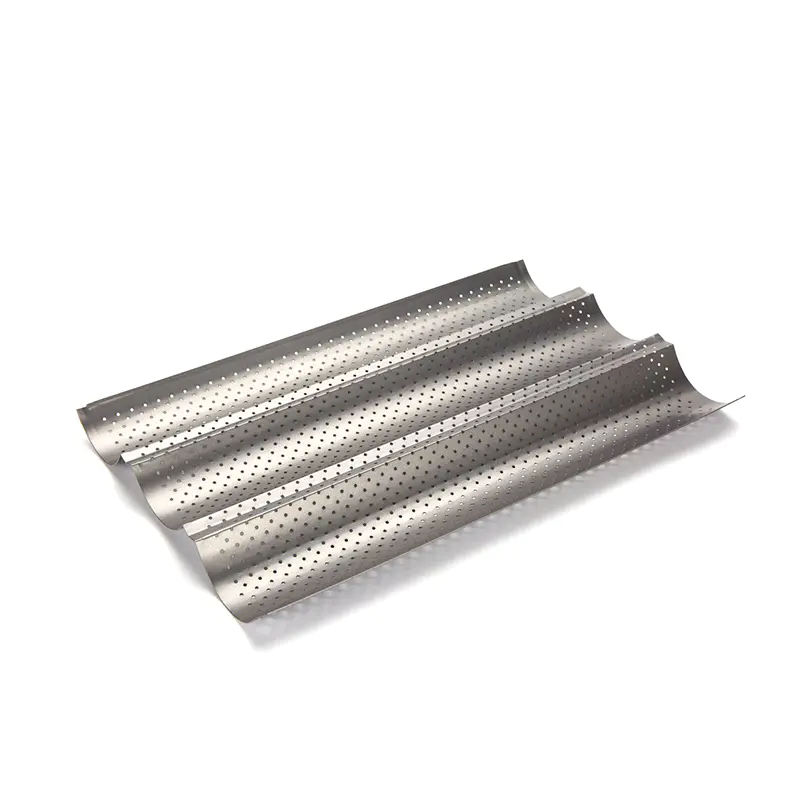
Carbon steel is the standard material for this product category because it distributes oven heat evenly across the tray's length, which matters more here than on shorter, wider bakeware where heat variation across the surface is less pronounced. A baguette baking tray built from a heavier gauge steel resists warping better under the repeated high-temperature cycling that commercial ovens put bakeware through, since thinner material can develop a slight bow over time that throws off even contact between the dough and the tray surface.
Groove Spacing and Tapered Ends Shape the Loaf
The individual grooves in a multi-loaf tray need enough separation to prevent adjacent loaves from touching and fusing together as the dough expands during baking, while the tapered ends of each groove guide the dough into the traditional elongated baguette shape rather than allowing it to spread unevenly. A baguette baking tray with grooves spaced too closely produces loaves with flattened, fused sides, a defect that shows up consistently across a batch rather than as an occasional outlier — which makes groove spacing a specification worth confirming on a sample before a bulk order rather than assuming it from a product photo.
Matching Cavity Count to Commercial Volume
Trays in this category commonly come in two, three, and four-loaf configurations, and the right cavity count depends on oven size and batch volume rather than personal preference. A baguette baking tray with more cavities increases throughput per bake cycle, but only if the oven has enough consistent heat distribution across its full width to bake every cavity evenly — a four-loaf tray in an oven with uneven heat zones can produce inconsistent results between the outer and inner grooves, which is a factor worth testing before standardizing an order around the largest available configuration.
Non-Stick Coating Trade-Offs for High-Volume Use
A non-stick coating simplifies release and cleanup, but coated surfaces generally wear faster under high-volume commercial use than the natural release properties of well-seasoned bare carbon steel. A baguette baking tray intended for daily commercial bakery use should be evaluated on coating durability specifically, since a coating that degrades after a few months of heavy use creates a recurring replacement cost that a bare steel or heavier-gauge coated alternative might avoid.
What Buyers Typically Compare
For bakeware distributors and commercial kitchen suppliers sourcing this category, useful comparison points include perforation size and spacing relative to the intended crust style, steel gauge relative to expected oven cycling frequency, groove spacing and taper consistency across a sample batch, and coating durability under repeated commercial use. Zhejiang Bakeware Industry and Trade Co., Ltd., operating from Yongkang City, Jinhua, Zhejiang, and certified to ISO9001 and BSCI standards, produces its baguette baking tray range across two, three, and four-loaf configurations in both coated and bare carbon steel finishes, within a broader bakeware lineup covering cake pans, loaf pans, and commercial baking trays.