


 English
  Deutsch
  Español
 A fry tray that looks right in a photo can still disappoint in a customer's kitchen if it does not fit the appliance it was bought for. A French Fry Baking Tray is usually bought for one appliance at a time: a full-size home oven, a toaster oven or an air fryer. The tray has to sit flat, clear the heating element and leave room for hot air to move around the fries.
Fit comes before features
Oven racks set the opening limit. A tray that is wider than the space between the rack guides will not slide in, and a tray with wide handles can be too wide even when the pan itself is the right size. Toaster ovens and air fryers narrow the margin further for a French Fry Baking Tray, since their cavity is smaller and the distance between the heating element and the rack is short. A French Fry Baking Tray that is slightly too tall can touch the element, and one that is slightly too long can block the door.
For this reason, buyers selling a French Fry Baking Tray to home cooks list length, width and height on the product page, not a single size name. Customers compare those three numbers with the inside of their own oven before they order, and a listing that gives them clearly saves returns.
Airflow around the fries
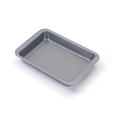
Fries crisp when hot air reaches every side, and a French Fry Baking Tray is judged on how well it allows that. A solid flat sheet traps steam under the potatoes and leaves the underside soft, while a perforated or mesh crisper tray lets steam and oil drain away and keeps air moving beneath the fries. The opening size matters as much as the opening count. Holes that are too large let thin cuts fall through, and holes that are too small clog with oil and starch, so the opening should suit the thinnest cut the tray is sold for.
Spacing on a crisper tray also affects how evenly the fries cook. A tray with a solid border and a perforated centre gives the cook a flat edge to hold and an open area for airflow. A crisper tray that is perforated edge to edge cooks evenly across the whole surface, but it offers less support to the hand when it comes out of a hot oven.
Rim height and drips
A rim on a French Fry Baking Tray does two jobs. It keeps loose fries on the tray when the cook pulls it from the oven, and it holds back oil that drains from the potatoes. A very low rim lets fries slide off, while a very high rim blocks the air that should move across the surface. A middle height, enough to stop a slide but low enough to leave the airflow open, suits many oven fries.
Oil that drains through a perforated surface needs somewhere to go. Many cooks place a plain sheet pan on the rack below to catch drips, and a product page that mentions this saves a customer from a messy oven floor. A French Fry Baking Tray sold with a matching drip pan solves the problem in one purchase.
Cleaning is part of the purchase decision as well. Fries leave oil and starch on the surface, so a smooth finish that rinses clean and a tray that fits the sink and the dishwasher rack save customers effort after every meal. That practical detail belongs on the listing next to the size.
Listing the tray for retail and food service
Zhejiang Bakeware Industry and Trade lists baking trays among more than 1,000 bakeware varieties, alongside pizza pans and cookie sheets. A fry tray fits naturally beside those items because it uses the same sheet-metal skills and the same coating options. Buyers can build a small range from one footprint, for example one tray sized for a full oven and one smaller tray for a toaster oven or air fryer.
Food service buyers look at different details. A commercial kitchen wants trays that match its rack spacing and stack neatly in storage. A French Fry Baking Tray built to the same footprint as the kitchen's other sheet pans is easier to store, move and replace.
Retail buyers can ask for private label packaging, a printed size guide on the sleeve and a short care note. Customers who know the tray's dimensions before they open the box rarely return it for a fit problem. When a French Fry Baking Tray arrives with its size clearly printed, the buyer, the retailer and the cook all start from the same numbers.