


 English
  Deutsch
  Español
 A pan large enough to bake a full sheet cake puts more surface area under heat stress than a smaller round or square equivalent, which means small manufacturing inconsistencies that go unnoticed on a compact pan become visible warping and uneven baking on a full-size sheet. A Sheet Cake Pan depends on gauge consistency across its entire surface far more than smaller bakeware formats do, since there's simply more metal that has to expand and contract evenly during every bake cycle.
Surface Area Amplifies Small Manufacturing Variances
A Sheet Cake Pan spans considerably more surface area than a round or square pan of comparable depth, and this larger footprint means variation in steel gauge across the sheet becomes proportionally more visible once the pan goes through repeated heat cycling. A large format cake pan with a thin spot near the center, for example, will flex slightly more at that point than the surrounding metal, creating a shallow dip that shows up as uneven batter depth and inconsistent baking time across the same cake. Buyers should confirm gauge consistency testing on a Sheet Cake Pan extends across the full pan surface rather than relying on edge measurements alone, since edges are typically reinforced and less representative of center-panel thickness.
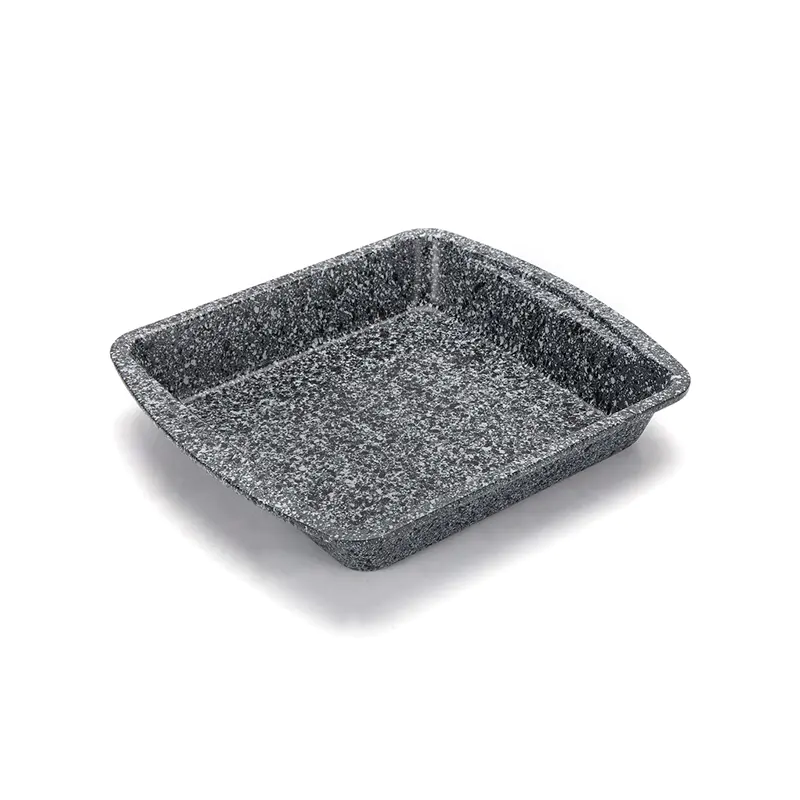
Rolled Edges Provide Structural Support Across a Wide Span
A rolled edge baking pan resists the bending that a raw-cut edge develops under the combined weight of batter and repeated oven handling, and this support matters more for sheet-format pans than smaller pans simply because there's more unsupported span between the rolled edge and the center of the pan. Buyers sourcing for commercial kitchens should confirm rim depth and rolled-edge thickness specifically, since a shallow rolled edge on a large sheet pan provides less resistance to flexing than the same edge treatment would on a compact pan with less surface area to support.
Comparing Gauge Options for Sheet-Format Baking
|
Gauge Option |
Warping Resistance |
Weight |
Suited Use Frequency |
|
Standard Gauge |
Moderate |
Lighter |
Occasional home or light commercial use |
|
Heavy Gauge |
Higher |
Heavier |
Daily commercial production |
|
Reinforced Rim, Standard Gauge |
Improved at edges only |
Moderate |
Mixed-frequency use |
Buyers supplying commercial bakeries running daily production should specify heavy gauge construction despite the added shipping weight, since warping under frequent heat cycling creates ongoing quality complaints that outweigh the modest cost savings of a lighter pan.
Even Heat Distribution Depends on Material Choice and Thickness Together
A carbon steel sheet cake pan conducts heat consistently across its surface when thickness stays uniform, but the material choice alone doesn't guarantee even baking if thickness varies from one production batch to the next. Buyers comparing suppliers should request thickness measurements taken at multiple points across a sample pan rather than a single center-point reading, since a supplier reporting only the single thickest measurement point can mask inconsistency elsewhere on the same pan.
Non-Stick Coating Application on Large Surfaces Presents Its Own Challenge
Applying non-stick coating evenly across a Sheet Cake Pan's full surface area requires more consistent spray or dip application than a smaller pan needs, since coating thickness that varies slightly across a compact pan is less noticeable than the same variance spread across a much larger surface. Buyers should ask suppliers whether coating thickness on a Sheet Cake Pan is verified at multiple points across the pan rather than only near the center, since corners and edges on a large sheet pan are more prone to thin coating coverage during high-volume production runs.
Certification and Bulk Supply for Commercial Kitchen Distributors
A Sheet Cake Pan destined for commercial kitchen distribution should carry documentation confirming the base material and coating meet food-contact safety standards relevant to the destination market, alongside factory-level quality certification covering the production facility. Buyers placing bulk orders for commercial kitchen equipment distributors should confirm minimum order quantities across different gauge and coating combinations, since a distributor stocking both light-duty and heavy-duty options within the same order can serve a broader range of commercial kitchen customers without committing full container volume to a single specification.